Through the Lens of Antiquity: Capturing Ephesus in Light and Stone
Have you ever pointed your camera at an ancient wall and felt time stop? Walking through Ephesus, I didn’t just see ruins—I saw stories etched in marble, shadows dancing on temple columns, and golden light wrapping the Library of Celsus like a secret. This isn’t just photography; it’s conversation with history. Every frame here captures more than stone—it holds art, culture, and the quiet breath of a civilization that still speaks—if you know how to listen. For photographers and lovers of heritage, Ephesus offers a rare convergence: an exceptionally preserved ancient city where light, architecture, and narrative align to create images that are both visually striking and deeply meaningful. This journey is not merely about capturing beautiful scenes, but about honoring a legacy through the lens.
The First Glimpse: Entering Ephesus Through a Photographer’s Eyes
Approaching Ephesus from the modern world feels like stepping into a different dimension. The transition from the surrounding Turkish countryside to the towering remains of the city gate is abrupt and powerful. As visitors pass through the Magnesia Gate, the first full view of the Marble Road unfolds—an impeccably preserved colonnaded avenue stretching into the distance, flanked by weathered columns and fragments of ancient life. For a photographer, this moment is transformative. The textures of limestone and marble, worn smooth by centuries of footsteps, catch the early morning light in ways that reveal depth and history in every crevice. The interplay of shadow and illumination along the road sets a visual rhythm, ideal for wide-angle compositions that emphasize perspective and scale.
Lighting conditions in Ephesus vary dramatically throughout the day, making timing a crucial factor in capturing its essence. Early morning, just after sunrise, bathes the site in soft, diffused light with long shadows that enhance texture and dimension. Midday sun, while harsh and often unflattering, can be used creatively for high-contrast black-and-white photography, especially when focusing on architectural details. Late afternoon offers the most poetic illumination, with golden hour casting warm tones across the ruins, softening edges and highlighting contours. Photographers are advised to arrive at opening time to avoid crowds and make the most of the delicate morning light, which enhances the subtlety of stone carvings and pavement patterns.
From a technical standpoint, wide-angle lenses (between 16mm and 35mm) are ideal for capturing the expansive views of the city’s layout, particularly when photographing long stretches of the Marble Road or panoramic vistas from elevated positions. A tripod is recommended for early or late shooting when light levels are low, ensuring sharpness without increasing ISO unnecessarily. Aperture settings between f/8 and f/11 provide optimal depth of field, keeping both foreground details and distant structures in focus. Ephesus is not merely a subject for photography—it is a living canvas where symmetry, proportion, and historical atmosphere converge, inviting the photographer to explore not just what is seen, but what is felt in the silence between the stones.
The Library of Celsus at Golden Hour: A Must-Capture Moment
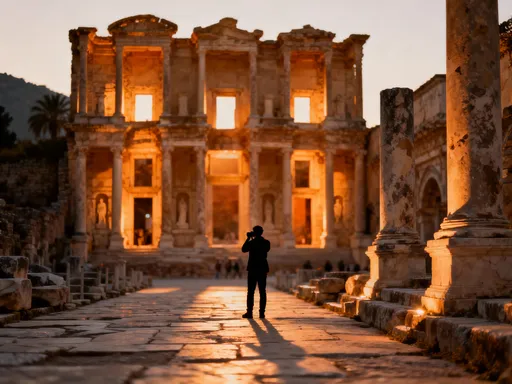
No image of Ephesus is more iconic than the façade of the Library of Celsus, especially when illuminated by the golden light of late afternoon. This two-story structure, meticulously reconstructed from original fragments, stands as a masterpiece of Roman architecture and a symbol of intellectual heritage. Originally built in the 2nd century AD to house over 12,000 scrolls, the library was dedicated to Tiberius Julius Celsus Polemaeanus, a Roman senator of Greek descent, and served as both a cultural center and a monumental tomb. Its ornate façade—featuring Corinthian columns, sculpted niches, and intricate reliefs representing personifications of wisdom, virtue, intelligence, and valor—offers a wealth of photographic opportunities.
The magic of photographing the Library of Celsus lies in timing. While morning light reveals fine details with even illumination, the late afternoon sun strikes the façade at a low angle, creating dramatic contrasts between light and shadow. This directional light accentuates the depth of the columns and the relief carvings, transforming the surface into a dynamic play of textures. The warm glow that bathes the pale stone during golden hour enhances the sense of timelessness, making the library appear almost ethereal. For the most compelling compositions, photographers should position themselves slightly to the left or right of center to avoid flat, head-on shots. This angle introduces perspective and depth, allowing the eye to travel across the façade’s layered design.
To capture the full impact of the scene, a polarizing filter can help reduce glare on the stone surface and deepen the blue tones of the sky, creating a more balanced exposure. Because the site can attract large numbers of visitors in the late afternoon, arriving at least 30 minutes before sunset ensures time to secure a good vantage point. Some photographers choose to include silhouetted figures in the foreground to convey scale and human connection, though care should be taken not to disrupt the historical mood. The Library of Celsus is more than a photogenic monument—it is a testament to the enduring value of knowledge, and photographing it at its most radiant moment is a way of paying tribute to that legacy.
Temple of Hadrian and Hidden Details: Seeking the Art in the Stone
While the Library of Celsus draws the crowds, the Temple of Hadrian offers a quieter but equally rewarding experience for the discerning photographer. Nestled along the Marble Road, this well-preserved structure dates back to the 2nd century AD and was dedicated to the Roman Emperor Hadrian, who visited Ephesus during his travels through the empire. Though smaller in scale than other monuments, its architectural refinement and sculptural details make it a treasure trove for close-up and macro photography. The temple’s entablature features a remarkable frieze depicting mythological scenes, including the legendary founding of Rome by Romulus and Remus, as well as the appearance of the goddess Tyche, symbolizing the city’s prosperity.
What sets the Temple of Hadrian apart is the level of craftsmanship visible in its carvings. The Corinthian capital, with its delicate acanthus leaves and scrolling volutes, is a masterpiece of proportion and precision. Photographers using macro lenses can isolate these details, revealing textures and tool marks that speak to the hands that shaped them nearly two millennia ago. Low-angle shots emphasizing the curvature of the columns or the interplay of light within the temple’s niche can create compelling compositions. Because the temple is partially shaded by surrounding structures, lighting can be uneven, making it essential to adjust exposure settings carefully. Using spot metering on the carved sections helps preserve detail in both highlights and shadows.
Post-processing techniques can further enhance these close-up images without compromising authenticity. Increasing clarity and contrast slightly brings out the depth of the carvings, while careful sharpening reveals fine lines in the stone. However, over-editing should be avoided, as it risks distorting the natural weathering that gives the site its character. The Temple of Hadrian reminds us that beauty in archaeology often lies not in grandeur, but in the subtleties—the way a leaf is chiseled, the curve of a drapery fold, the quiet dignity of a forgotten inscription. These details, when captured with care, become visual stories that connect modern viewers to the artisans and beliefs of the ancient world.
The Terrace Houses: Color, Life, and Domestic Art Frozen in Time
A short climb from the main thoroughfare leads to the Terrace Houses, one of Ephesus’s most revealing and visually rich areas. These multi-level residences, once home to the city’s elite, offer a rare glimpse into domestic life in the Roman era. Unlike the public monuments, which emphasize power and civic identity, the Terrace Houses reveal personal tastes, social customs, and artistic sensibilities. Their preserved frescoes—still vivid in hues of red, yellow, and blue—depict mythological scenes, floral patterns, and architectural illusions, showcasing the sophisticated aesthetics of Ephesian homeowners. Mosaics adorn the floors, and intact heating systems (hypocausts) demonstrate advanced engineering for comfort and luxury.
Photographing the interiors of the Terrace Houses presents unique challenges due to limited natural light. Most rooms are small and windowless, relying on light from open courtyards or upper openings. To capture the true colors of the frescoes without introducing noise, photographers should use a tripod and set their cameras to low ISO (100–200). Aperture settings between f/4 and f/5.6 allow sufficient light while maintaining depth of field, especially when focusing on wall details. Because flash photography is prohibited to protect the delicate pigments, reliance on ambient light and longer exposures is necessary. Some photographers use manual white balance settings to correct for the warm tone of indoor lighting, ensuring color accuracy in their images.
These homes provide more than artistic inspiration—they tell stories of family, status, and daily rituals. The arrangement of rooms reflects social hierarchy, with public reception areas near the entrance and private quarters deeper within. Courtyards served as social and functional centers, often decorated with fountains and sculptures. Photographing these spaces requires sensitivity to their intimate nature; wide shots that include entire rooms help convey layout and atmosphere, while close-ups of painted details invite viewers to imagine the lives once lived there. The Terrace Houses transform Ephesus from a city of monuments into a lived-in world, where art was not confined to temples but woven into the fabric of everyday existence.
Framing the Processional Way: Symmetry, Scale, and Urban Design
The Curetes Street, also known as the Processional Way, was the ceremonial and commercial heart of Ephesus. Lined with columns, shops, and public fountains, this grand avenue connected the harbor to the Temple of Artemis, one of the Seven Wonders of the Ancient World. Though the temple itself no longer stands, the street remains a powerful testament to Roman urban planning. Its precise alignment, rhythmic repetition of columns, and gradual incline create a natural perspective that is irresistible to photographers. Capturing the full length of the street from a low angle emphasizes its symmetry and vanishing point, drawing the viewer’s eye deep into the city’s past.
For compelling compositions, photographers should experiment with different viewpoints. Shooting from ground level with a wide-angle lens exaggerates the height of the columns and enhances the sense of depth. Elevated positions, such as the upper terraces near the Library of Celsus or the Church of Mary, offer panoramic views of the street’s trajectory, revealing how it integrates with the surrounding topography. These vantage points also allow for creative framing, using archways or column alignments to lead the eye toward key landmarks. The use of leading lines—whether from the pavement, column rows, or rooflines—adds structure and movement to the image, reflecting the intentional design of the ancient city.
Ephesus was not built by accident; its layout reflects a sophisticated understanding of engineering, aesthetics, and social function. The Processional Way was designed to impress—both visually and symbolically—guiding visitors through a carefully orchestrated experience of power, commerce, and religion. Photographs that capture this intention reveal more than architecture; they document a worldview. The alignment of buildings, the placement of statues, and the flow of foot traffic were all part of a larger narrative about civic identity and divine favor. By framing these elements with intention, modern photographers participate in that narrative, translating ancient design into contemporary visual language.
People in the Past: Capturing Visitors Without Breaking the Silence
One of the most delicate challenges in photographing Ephesus is how to include people—both as subjects and as unavoidable presences—without disrupting the sense of timelessness. Unlike studio photography, where control is total, heritage sites are living spaces shared with tourists, guides, and local staff. The presence of modern figures in ancient settings can either enhance or detract from the image, depending on how they are framed. When used thoughtfully, human elements can convey scale, evoke emotion, and create a bridge between past and present. A lone figure walking down the Marble Road, for example, can emphasize the grandeur of the space and suggest continuity across centuries.
Several techniques allow photographers to integrate people respectfully. Silhouettes work particularly well during sunrise or sunset, when the backlight creates dramatic outlines against the ruins. Distant figures, blurred by a shallow depth of field, add life without distracting from architectural details. Reflections in puddles or polished stone surfaces can introduce human presence subtly, almost like ghosts from another era. Some photographers wait patiently for moments when the site clears, especially early in the morning or during off-season visits, to capture pristine, uninhabited scenes. Others embrace the reality of shared space, using candid shots of visitors gazing at inscriptions or tracing carvings with their fingers to highlight engagement with history.
Ethical considerations are equally important. Flash photography near fragile surfaces is prohibited, and drones are not permitted within the archaeological zone. Respecting these rules ensures the preservation of the site for future generations. Additionally, photographing other visitors should be done discreetly and without intrusion. The goal is not to create staged scenes, but to document authentic interactions with heritage. When people are included with intention, they become part of the story—not as distractions, but as witnesses to a legacy that continues to inspire.
From Raw to Refined: Post-Processing with Respect
The final stage of photographing Ephesus extends beyond the shutter click—it continues in the digital darkroom. Post-processing is not about altering reality, but about revealing what the camera sensor captured under challenging conditions. The goal should always be authenticity: to present the site as it appeared in natural light, with enhanced clarity and balanced tones. Basic adjustments—such as correcting exposure, white balance, and lens distortion—help restore the true colors and geometry of the ruins. Increasing contrast slightly can bring out the texture of weathered stone, while moderate clarity adjustments emphasize architectural details without creating artificial sharpness.
Color temperature plays a crucial role in conveying mood. Images taken during golden hour should retain their warm tones, as these reflect actual lighting conditions and contribute to the emotional resonance of the scene. Over-saturation, however, can make colors appear unnatural and detract from the site’s dignity. Similarly, excessive shadow recovery or highlight clipping can flatten the image and erase the subtle gradations that give stone its depth. Noise reduction should be applied carefully, especially in low-light shots from the Terrace Houses, to preserve detail while minimizing grain.
Some photographers choose to convert images to black and white, a powerful approach for emphasizing form, contrast, and timelessness. This style works particularly well for architectural studies, where the absence of color directs attention to line, shape, and texture. Regardless of editing style, the principle remains the same: to honor the integrity of the site. Each photograph should serve as a respectful tribute, not a fantasy. When done with care, post-processing transforms raw files into meaningful representations of Ephesian art and culture, preserving their beauty for viewers around the world.
Final Thoughts: Why Ephesus Belongs in Every Lens
Ephesus is more than an archaeological site—it is a dialogue between past and present, between stone and light, between observer and observed. For photographers, it offers a rare opportunity to create images that are not only visually compelling but culturally significant. Every column, fresco, and cobblestone tells a story, and every photograph has the power to keep that story alive. The techniques discussed—from optimal lighting and composition to ethical post-processing—are not just tools for better images, but ways of engaging mindfully with heritage.
Capturing Ephesus is not about taking pictures; it is about bearing witness. It is about recognizing that beauty endures, that art transcends time, and that human expression—whether in marble or memory—deserves to be seen. As more people visit and photograph this ancient city, the collective visual record grows, contributing to global appreciation and preservation. By approaching Ephesus with respect, patience, and intention, photographers do more than document ruins—they help sustain a legacy. In every frame, there is a chance to listen to the quiet breath of history and to ensure that its voice continues to be heard.