You Won’t Believe These Secret Spots in Novosibirsk
Novosibirsk isn’t just Russia’s third-largest city—it’s a hidden gem with views most travelers never see. I wandered its streets, chased sunsets, and found vantage points that took my breath away. From quiet riverbanks to rooftop surprises, the city reveals itself slowly. If you’re looking for beauty beyond the guidebooks, keep reading—these secret viewpoints are totally worth it.
Why Novosibirsk Deserves More Than a Passing Glance
Often overlooked in favor of Moscow or St. Petersburg, Novosibirsk quietly stands as a cultural and scientific beacon in the heart of Siberia. Located where the Trans-Siberian Railway crosses the mighty Ob River, the city was born from progress and has grown into a vibrant urban center that balances modern life with natural serenity. Far from the icy, barren image many associate with Siberia, Novosibirsk thrives with green parks, wide boulevards, and a surprising warmth in both its climate and its people.
Travelers sometimes assume Siberian cities are cold, industrial, and culturally sparse—but Novosibirsk defies these stereotypes. It is home to one of Russia’s most respected academic communities, a thriving arts scene, and a population that values education, music, and outdoor life. The city’s architecture reflects this duality: grand Soviet-era buildings stand alongside sleek modern developments, while tree-lined avenues soften the urban landscape. This blend of intellect and nature creates a rhythm that feels both grounded and inspiring.
What makes Novosibirsk truly special is its relationship with the environment. Unlike many large cities that dominate their surroundings, Novosibirsk coexists with the vast Siberian terrain. Forests and rivers are not just outskirts—they are woven into the city’s identity. Residents take pride in their access to nature, often escaping to parks or riverbanks after work. For the observant traveler, this harmony between urban life and natural beauty offers a quiet charm that unfolds over time, not in a single glance.
The Ob River Embankment: Where the City Breathes
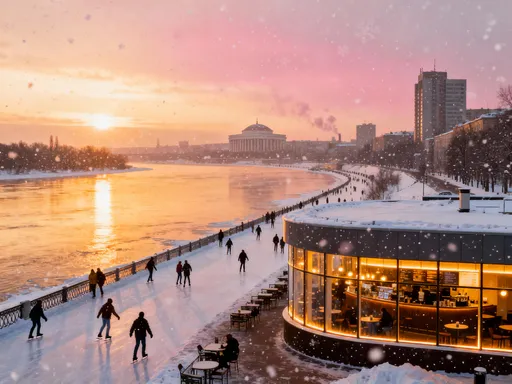
The Ob River is the lifeblood of Novosibirsk, and its embankment is where the city comes to relax, reflect, and reconnect. Stretching along the southern bank, the riverside walkway is a favorite among locals, especially in the late afternoon when the golden light washes over the water. Benches line the path, some tucked beneath weeping willows, others perched on gentle slopes offering unobstructed views of the river’s slow current and the distant hills beyond.
While the main promenade is well-known, the true magic lies in the smaller, less-traveled paths that branch off to the west. These hidden trails wind through low shrubs and wildflowers, leading to secluded spots where the only sounds are the rustle of leaves and the occasional lap of water against the shore. One such path, just past the pedestrian bridge near the Novosibirsk Opera and Ballet Theatre, opens onto a grassy knoll that feels miles from the city—yet it’s only a ten-minute walk from the center.
Morning and evening are the best times to experience the embankment’s full atmosphere. At sunrise, mist rises from the river like breath in the cold air, softening the skyline. By sunset, the western-facing views become especially dramatic, with the sun dipping behind the city’s skyline and casting long shadows across the water. Couples stroll hand in hand, joggers pass by in steady rhythm, and elderly residents sit quietly, watching the world move at its own pace. It’s here that Novosibirsk feels most alive—not in grand gestures, but in these small, daily rituals.
Lenin Square at Dusk: Urban Grandeur with a Human Touch
At the center of Novosibirsk lies Lenin Square, a broad open space framed by imposing buildings and anchored by a towering statue of Vladimir Lenin. While some may see it as a relic of the past, the square has evolved into a living part of the city’s present. At dusk, when the streetlights flicker on and the last golden rays catch the pale stone facades, the square transforms into a place of quiet majesty. The contrast between the monumental architecture and the soft evening light creates a scene that is both grand and intimate.
The buildings surrounding the square—home to government offices, cultural institutions, and the Novosibirsk Conservatory—take on a warm glow as artificial and natural light blend. The symmetrical layout, often bustling during the day, becomes serene after sunset. Fewer people pass through, and those who do move slowly, perhaps pausing to look up at the illuminated clock tower or to listen to the faint sound of piano practice drifting from an open window. It’s a moment when the city seems to pause, offering a rare stillness in an otherwise active urban center.
For photographers and casual observers alike, the best vantage point is from the southwest corner, near the entrance to Gorky Central Park of Culture and Leisure. From here, the entire square unfolds in a single frame, with Lenin’s statue silhouetted against the fading sky. To avoid crowds, visit just after 7:00 PM in summer or before 8:00 PM in winter, when most office workers have gone home but the lights are still bright. The result is a peaceful urban portrait—one that captures both the history and the quiet dignity of Novosibirsk.
The Railway Station Dome: A Forgotten Panorama Above the Tracks
Rising above the main railway station, the dome of the Novosibirsk-Glavny building is one of the city’s most recognizable landmarks—yet few travelers ever look up with curiosity. Completed in the early 20th century, the station was designed to reflect the importance of the Trans-Siberian Railway, and its grand dome was meant to inspire awe. Today, while passengers rush through the concourse, the upper levels remain a quiet, overlooked space that offers a unique aerial perspective of the city.
Though public access to the very top is restricted, there are still opportunities to gain elevation. A staircase near the central hall leads to a second-level balcony that wraps around the interior of the dome. From here, visitors can look down on the bustling ticket counters and waiting areas while also peering through arched windows that face outward in all directions. To the north, the view extends over the train platforms, where long freight and passenger cars sit waiting under pale platform lights. To the south, the city skyline emerges—low-rise buildings giving way to taller structures near the river.
What makes this viewpoint special is the sense of movement it captures. Trains arrive and depart with rhythmic precision, their horns echoing through the steel canopy. The distant hills, often hazy in the summer heat, become clearer in the crisp morning air. For a brief moment, the observer is suspended between travel and arrival, between the journey and the destination. It’s a reminder that Novosibirsk is not just a place, but a crossroads—one where thousands pass through, yet few take the time to truly see.
Zayeltsovskiy Park: Nature’s Overlook in the Northern District
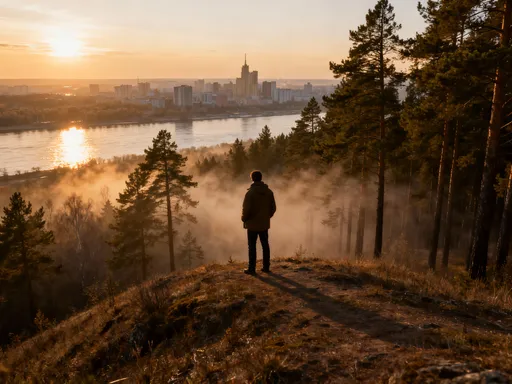
Nestled in the northern part of the city, Zayeltsovskiy Park is one of Novosibirsk’s best-kept secrets—a vast green sanctuary where nature takes center stage. Unlike more manicured city parks, this forested area feels wild and untouched, with winding trails that climb gentle slopes and open onto clearings with sweeping views of the Ob River’s northern bend. It’s a place where the city’s noise fades, replaced by birdsong, wind in the pines, and the crunch of leaves underfoot.
The park’s elevated trails offer some of the most peaceful vantage points in Novosibirsk. One path, beginning near the park’s eastern entrance, rises steadily through birch and fir trees before opening onto a rocky outcrop that overlooks a quiet stretch of the river. In summer, the view is a tapestry of green—dense foliage, shimmering water, and the occasional sailboat drifting by. In winter, the same spot becomes a monochrome dreamscape, with snow-covered trees standing like sentinels over a frozen world.
Locals come here for solitude and rejuvenation. Families picnic in the warmer months, while elderly couples walk slowly along the shaded paths, stopping to rest on weathered wooden benches. On weekends, you might see a small group practicing tai chi in a sunlit clearing or a lone artist sketching the landscape. There are no crowds, no vendors, no distractions—just the simple pleasure of being outdoors. For visitors, the park offers a chance to experience how Novosibirsk residents truly live, finding peace not in grand monuments, but in the quiet embrace of nature.
The Akademgorodok Hills: Science Meets Scenic Beauty
A short drive from the city center, Akademgorodok—literally “Academic Town”—is a unique district built around one of Russia’s most important scientific centers. Founded in the 1950s, it was designed as a haven for researchers and intellectuals, nestled in a pine forest along the banks of Lake Belyy. Today, it remains a place of quiet inspiration, where tree-lined roads connect research institutes, residential homes, and small cafes. But beyond its academic reputation, Akademgorodok offers some of the most breathtaking natural views in the region.
The hills surrounding the lake provide a series of gentle elevations perfect for walking and reflection. One popular route begins at the main entrance near the Institute of Nuclear Physics and follows a paved path that curves upward through the woods. As the trail climbs, the canopy opens, revealing glimpses of the lake below—its surface mirror-like in the early morning, rippling gently in the afternoon breeze. In autumn, the hills blaze with color; in spring, wildflowers bloom along the edges of the path.
Sunset here is a quiet event, but deeply moving. As the sun dips behind the western treeline, it bathes the lake in golden light, turning the water into liquid amber. The pine forests deepen to a rich green, and the white walls of the research buildings glow softly. It’s a moment of harmony between human achievement and natural beauty—a reminder that progress need not come at the expense of peace. Many scientists and students walk these paths after work, not just for exercise, but to clear their minds. For the visitor, it’s an invitation to slow down and appreciate a different kind of urban life—one where knowledge and landscape coexist in balance.
Rooftop Views and Urban Exploration: Finding High Ground Legally
In a city like Novosibirsk, where open spaces and natural elevation are scattered, gaining a higher perspective can feel like a small victory. While climbing rooftops is neither safe nor permitted, there are still legal and respectful ways to experience the city from above. Several shopping centers and public buildings offer accessible upper levels with expansive views, especially at twilight when the city lights begin to sparkle.
One of the best spots is the rooftop terrace of the Sibirskiy Trakt shopping complex, located near the city center. Though not widely advertised, the top floor features a wide walkway that wraps around the building, offering clear sightlines to the Ob River, the railway station, and the distant hills. In the evening, families often come here to walk or sit on benches, enjoying the cool air and the view. The lighting is soft, the atmosphere calm—there are no loud attractions or crowds, just a quiet urban panorama.
Another option is the stairwell of the main library building on Krasny Avenue. While the interior is not open to the public after hours, the upper floors can be accessed during opening times, and the large windows on the fifth floor face west, providing a stunning view of the sunset over the city’s rooftops. Similarly, some hotels with restaurants or observation areas—such as those near the Opera House—allow guests and visitors to linger on upper floors, especially during dinner hours. The key is to be respectful: observe posted rules, avoid restricted areas, and remember that these spaces are shared. Urban exploration at its best is not about trespassing, but about curiosity guided by care.
Conclusion: Seeing Novosibirsk with New Eyes
Novosibirsk is not a city that reveals itself all at once. It does not shout for attention like larger metropolises, nor does it dazzle with constant spectacle. Instead, it offers its beauty in quiet moments—in the way the light hits the river at dusk, in the hush of a forested hillside, in the stillness of a nearly empty square. The viewpoints shared here are not marked on most tourist maps, but they are real, accessible, and deeply rewarding for those who take the time to look.
What these secret spots have in common is their ability to slow us down. They invite observation, reflection, and connection—not just to the city, but to the simple act of being present. Whether you’re standing on a hidden riverbank, walking through a pine-scented trail, or gazing out from a quiet balcony, you begin to see Novosibirsk not as a stopover on the Trans-Siberian Railway, but as a place with its own rhythm, its own soul.
To truly experience a city, one must look beyond the obvious. The best views are not always the tallest or the most famous—they are the ones discovered through curiosity, patience, and a willingness to wander. In Novosibirsk, that journey is worth every step. So the next time you find yourself in Siberia’s largest urban center, don’t just pass through. Pause. Look up. Step off the main path. You might just find a perspective that changes the way you see everything.