You Won’t Believe What Vang Vieng Hides in Plain Sight
I never expected a sleepy riverside town in Laos to leave me breathless—literally and figuratively. Vang Vieng, once known for backpacker parties, has quietly transformed into a place where nature steals the spotlight. Towering limestone karsts, emerald rivers, and hidden caves create a viewing experience like no other. This is not just a destination; it’s a visual awakening. If you’re chasing raw, unfiltered beauty without the crowds, you gotta see it to believe it.
The First Glimpse: Arriving in Vang Vieng
As the minibus winds north from Vientiane along Route 13, the landscape gradually shifts from flat, cultivated plains to rolling green hills veiled in morning mist. Around every bend, the scenery becomes more dramatic, until suddenly, like silent giants rising from the earth, the limestone karsts of Vang Vieng appear on the horizon. This first view is unforgettable—a surreal skyline of jagged peaks cloaked in dense jungle, framing the sleepy town nestled beside the winding Nam Song River. For many visitors, this moment marks the beginning of a deeper connection with nature, a transition from the routine of daily life into a world shaped by time, water, and rock.
Arriving by private car offers flexibility, allowing travelers to pause at scenic pull-offs and take in panoramic views without rush. However, the most common and economical option remains the shared minibus, which departs daily from the capital and takes approximately three and a half hours. The journey itself becomes part of the experience, especially when timed for early morning departure. Sunlight filters through low-lying fog across rice paddies, gilding the edges of the fields and illuminating farmers tending their crops. By late afternoon, shadows stretch long across the valley, softening the contours of the karsts and giving the entire region a dreamlike quality.
The best time to arrive is just before or after midday, when the sun is high enough to reveal the full texture of the landscape but not so harsh as to wash out colors. Late arrivals, while convenient, may miss the golden-hour glow that bathes the cliffs in warm amber tones. For those seeking a serene introduction, an early evening entry offers a different kind of magic—fireflies flickering near the riverbanks, the distant call of birds settling for the night, and the quiet hum of village life winding down. No matter the hour, the first impression of Vang Vieng remains consistent: this is a place where nature speaks louder than noise, and stillness carries its own rhythm.
Above the Ground: Why the Karst Landscapes Dominate Your Senses
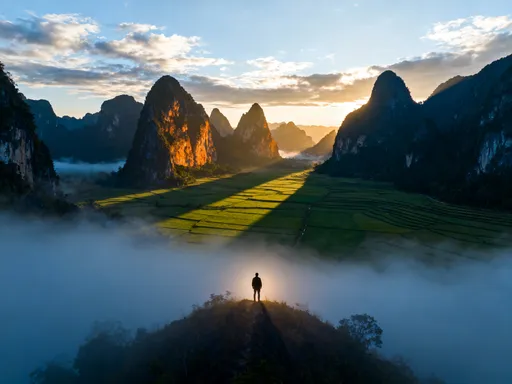
The limestone karsts that surround Vang Vieng are not merely scenic—they are geological masterpieces formed over millions of years through the slow dance of water and rock. These towering formations, some reaching heights of over 300 meters, were shaped by rain and river erosion dissolving soluble limestone, leaving behind dramatic spires, arches, and overhangs. The result is a landscape that feels both ancient and alive, where every ridge and crevice tells a story written in stone. When sunlight strikes the cliffs at dawn, the pale gray surfaces take on a golden hue, while shadows deepen in the folds, creating a three-dimensional tapestry of light and form.
What makes these formations so powerful is not just their scale, but the silence that accompanies them. Unlike bustling tourist hotspots, Vang Vieng’s karsts do not demand attention with crowds or signs—they simply exist, majestic and unmoved by time. Standing at the base of one, visitors often report a sense of humility, a feeling of being small in the presence of something far greater. This emotional response is central to the region’s appeal: it invites introspection, encouraging travelers to slow down and absorb rather than rush through.
For those who wish to experience the karsts from above, several elevated trails provide safe and accessible viewpoints. A moderate hike up a nearby hillside, following a well-marked path through tropical vegetation, leads to a vantage point overlooking the entire valley. From here, the Nam Song River snakes through the landscape like a silver ribbon, flanked by rice fields and dotted with traditional wooden homes. On clear days, the view extends for miles, offering a full appreciation of the region’s topography. Another popular option is a short climb to a natural overlook maintained by a local community, where simple benches allow for quiet contemplation. These spots are open to all fitness levels and require no technical gear, making them ideal for families and older travelers.
Safety and sustainability are prioritized in these areas. Signage in both Lao and English reminds visitors to stay on designated paths, avoid littering, and respect local customs. There are no fences or commercial developments marring the views—only nature in its unaltered state. This commitment to preservation ensures that future generations can experience the same awe-inspiring scenery. Whether seen from a distance or explored up close, the karsts of Vang Vieng remain the soul of the region, a constant reminder of Earth’s quiet, enduring power.
At Eye Level: Floating Through the Nam Song River
One of the most intimate ways to experience Vang Vieng is from the surface of the Nam Song River. Once associated with rowdy tubing parties, the river has undergone a transformation, now offering a peaceful, eco-conscious way to glide through the heart of the landscape. Modern river excursions emphasize respect for the environment, with many operators using biodegradable tubes, providing reusable water bottles, and organizing clean-up efforts before and after floats. The experience today is less about revelry and more about immersion—drifting slowly downstream, feet dangling in cool, clear water, surrounded by towering cliffs and lush greenery.
The river’s clarity allows glimpses of pebbled riverbeds and darting fish, while overhanging palm trees create natural canopies that filter sunlight into dappled patterns on the surface. Every few minutes, a new vista unfolds: a hidden cave mouth partially submerged, a waterfall cascading down a mossy cliff, or a village accessible only by water. Kayaking and bamboo rafting offer alternative ways to navigate the river, giving travelers more control over their pace and route. These options are particularly appealing to those who want to explore side channels or stop at quiet banks for a picnic or swim.
Eco-tourism companies have played a key role in reshaping river activities. Guided tours now include information about local ecology, water conservation, and cultural etiquette. Guides point out native plant species, explain the importance of protecting riverbanks from erosion, and share stories about how communities depend on the Nam Song for irrigation, fishing, and transportation. This educational component enriches the journey, turning a simple float into a meaningful encounter with place and people.
While the river remains a central attraction, the shift in tone reflects broader changes in Vang Vieng’s tourism model. Where loud music and plastic waste once dominated, there is now a focus on mindfulness and minimal impact. Visitors are encouraged to bring dry bags for personal items, avoid using sunscreen that harms aquatic life, and refrain from feeding fish or disturbing wildlife. The result is a calmer, cleaner river experience that aligns with the values of responsible travel. Floating down the Nam Song is no longer just a fun activity—it’s a meditation in motion, a chance to reconnect with nature at its own unhurried pace.
Below the Surface: The Hidden World of Caves and Grottoes
Beneath the surface of Vang Vieng lies another dimension—one of silence, mystery, and natural artistry. The region is home to numerous limestone caves, formed by centuries of water erosion carving intricate passages through solid rock. Among the most accessible are Tham Nam Nang and Tham Chang, both offering safe, guided entry points for visitors of all ages. These are not dark, dangerous labyrinths but illuminated wonders where sunlight filters through ceiling openings, casting beams that dance across reflective pools and ancient stalactites.
Walking into one of these caves is a sensory shift. The air cools instantly, the sounds of the outside world fade, and the acoustics change—every footstep echoes softly, every whisper carries. In Tham Nam Nang, a series of chambers open into a vast central hall where a still pool mirrors the cave ceiling, creating the illusion of infinite space. Natural light enters from above, shifting throughout the day, transforming the atmosphere from dim and mysterious in the morning to bright and ethereal by midday. Visitors often stand in silence, captivated by the interplay of light and water, feeling as though they’ve stepped into another realm.
Tham Chang, also known as the Elephant Cave, features large open chambers and historical significance, having served as a shelter during past conflicts. Today, it stands as a place of quiet reverence, where visitors move slowly and speak in hushed tones. Informational signs along the path explain the geology of the cave system and the importance of preserving its delicate formations. Flash photography is discouraged in sensitive zones to protect fragile mineral deposits, and flashlights are permitted only when provided by official guides.
Responsible visitation is critical. Local authorities and tour operators emphasize staying on marked trails, avoiding touching formations (oils from skin can damage centuries-old calcite), and refraining from leaving any trace. Graffiti, once a problem in some caves, has been largely eliminated through education and enforcement. Community-led initiatives now employ local residents as guides, ensuring that tourism benefits the people who know and care for these spaces most. Exploring the caves of Vang Vieng is not about thrill-seeking—it’s about reverence, discovery, and the quiet awe that comes from standing inside the Earth itself.
Off the Beaten Path: Secret Viewpoints Only Locals Knew
Beyond the main roads and popular trails lie hidden vantage points known primarily to villagers and long-time guides—places where the valley unfolds in uninterrupted splendor, free from crowds and commercialization. These spots are reached via short hikes along dirt paths, sometimes passing through rice fields or alongside grazing water buffalo. One such trail begins behind a small riverside village, following a gentle incline through bamboo groves and flowering shrubs. After about 20 minutes of walking, the path opens onto a rocky outcrop with a sweeping view of the entire karst basin, the Nam Song winding through like a living map.
Another lesser-known ascent starts near a cluster of traditional stilt houses, where a narrow footpath climbs steadily through shaded forest. The climb is moderate, suitable for most adults, and rewards hikers with a panoramic vista at sunset—when the western cliffs catch fire with color and mist begins to rise from the river. These locations offer more than just scenery; they provide a sense of discovery, a feeling of having uncovered something precious and private. Because they are not advertised or included in standard tour packages, they remain peaceful, allowing for moments of solitude and reflection.
Access to these areas is made possible through cooperation with local communities. Many trails cross private or communal land, and visitors are encouraged to seek permission or hire a local guide, often arranged through guesthouses or eco-lodges. This practice not only ensures respect for property rights but also supports rural livelihoods directly. Guides share knowledge passed down through generations—pointing out medicinal plants, explaining seasonal farming cycles, and telling stories about how families have lived in harmony with the land for decades.
Sustainable exploration means treading lightly. Travelers are reminded to carry out all waste, avoid picking plants or disturbing animals, and keep noise levels low. Dogs are kept on leashes if brought along, and drones are used sparingly and only with consent. The goal is not to conquer terrain but to move through it with care and gratitude. These secret viewpoints are not hidden because they are forbidden, but because they are cherished. By visiting them responsibly, travelers become part of a larger effort to protect Vang Vieng’s quiet beauty for years to come.
Through Local Eyes: How Culture Enhances the Visual Journey
The true richness of Vang Vieng lies not only in its landscapes but in the way human life is woven seamlessly into them. From dawn to dusk, the rhythms of village existence unfold in quiet harmony with nature. Early in the morning, farmers walk to their fields, hoes over shoulders, moving through mist-covered paddies where egrets stalk for fish. Children wave from wooden porches as bicycles rattle along dirt lanes. At sunrise, saffron-robed monks walk in silent procession through the streets, collecting alms in bamboo baskets—a daily ritual that connects the present to centuries of tradition.
These moments are not performances for tourists; they are genuine expressions of daily life. Observing them adds depth to the visual experience, grounding breathtaking scenery in a living, breathing culture. A rice field is not just a green patch in a photograph—it is the result of hard work, seasonal knowledge, and family legacy. A riverside home is not merely picturesque—it is a place of meals, laughter, and rest. Recognizing this transforms sightseeing into understanding.
Respectful engagement enhances the journey. Photographing people should always be done with permission, signaled by a smile, a nod, or a simple gesture. Many locals are happy to pose if asked politely, especially children who beam at the attention. But some moments are meant to be witnessed, not captured—such as a farmer bending to plant seedlings or an elder mending a fishing net in the shade. In these instances, presence is enough.
Small gestures build connection. Buying fruit from a roadside vendor, sharing a meal at a family-run restaurant, or learning a few words in Lao (“Sabaidee” for hello, “Khobchai” for thank you) go a long way. These interactions, though brief, create mutual respect and leave lasting impressions on both visitor and host. When travelers see Vang Vieng through local eyes, the landscape becomes more than a backdrop—it becomes a shared home, alive with stories, resilience, and quiet dignity.
Putting It All Together: Planning a Trip That Prioritizes Seeing, Not Just Doing
Visiting Vang Vieng is not about checking off attractions—it’s about creating space to truly see. To do this well, planning matters. The best time to visit is between November and February, when the weather is cool and dry, skies are clear, and humidity is low. During these months, visibility is optimal, morning fog adds atmosphere without obstruction, and outdoor activities are comfortable. March through May brings higher temperatures and increased haze, while the rainy season from June to October can make trails slippery and rivers swollen, though the landscape is at its greenest.
Choosing where to stay can enhance the experience. Riverside guesthouses and eco-lodges offer direct access to the Nam Song and unobstructed views of the karsts. Many are family-owned, providing a personal touch and supporting local economies. Rooms with balconies or open-air lounges allow guests to enjoy sunrise over the river or evening breezes after a day of exploration. Booking in advance is recommended during peak season, but even last-minute travelers can usually find clean, affordable options.
Packing thoughtfully supports a mindful journey. A lightweight camera or smartphone with good photo capabilities helps capture fleeting moments—the play of light on a cave wall, a child’s smile, the curve of the river at dusk. A reusable water bottle reduces plastic waste and stays cool when filled with filtered water available at most accommodations. Comfortable walking shoes, a wide-brimmed hat, and biodegradable sunscreen protect against the elements without harming the environment. Most importantly, bringing patience allows space for spontaneity—waiting for the right light, sitting quietly by the river, or lingering in conversation with a local.
Itineraries should balance activity with stillness. A morning hike followed by a slow river float, then an afternoon spent sketching or journaling, creates a rhythm that mirrors the landscape itself. Avoid over-scheduling; Vang Vieng rewards those who move slowly and observe deeply. Guidebooks and apps can help with navigation, but some of the best experiences come from wandering without a map, guided instead by curiosity and kindness. When travel becomes a practice of attention, the world reveals its hidden layers—not through spectacle, but through subtle, cumulative beauty.
Vang Vieng isn’t just a place you see—it’s one you absorb. Its power lies not in checklist attractions but in the quiet moments between them: a sunlit ridge, a ripple on the river, a hillside village at dusk. When travel becomes about seeing deeply, the world reveals its hidden layers. This is what transformative viewing feels like—and it’s waiting, silently, in the heart of Laos.