Wander Where Art Lives: Isfahan’s Soul Through the Eyes of a Traveler
Isfahan isn’t just a city—it’s a living canvas. From the whisper of silk in ancient bazaars to the sky-kissed domes glowing at dusk, every corner breathes art and history. I walked its alleys not as a tourist, but as a seeker, and found culture not in museums, but in moments: a calligrapher’s steady hand, a courtyard blooming with tilework, a stranger’s smile over steaming tea. This is travel that changes how you see beauty.
First Impressions: Stepping Into a Timeless City
Arriving in Isfahan feels like crossing a threshold not only in space but in time. The city unfolds gently, beginning with the quiet outskirts where mud-brick homes nestle beside fields of saffron, their purple blooms catching the early light. As the landscape shifts toward the urban core, the pace remains unhurried, yet the energy intensifies—not with noise, but with presence. Minarets rise like sentinels above the skyline, and the call to prayer drifts through the air like a thread connecting past and present. There is no jarring transition from countryside to city; instead, Isfahan integrates both with a harmony that feels intentional, almost poetic.
The first breath of Isfahan is unforgettable. The scent of saffron and cumin lingers in the breeze, mingling with the earthy aroma of sun-baked clay and freshly baked flatbread. The colors are immediate and vivid: women in flowing manteaus of deep indigo or emerald green, men in crisp white shirts and dark trousers, children chasing kites beneath archways painted in lapis and turquoise. Even the language feels like music—Persian spoken in soft, rolling cadences, punctuated by laughter and the occasional call of a street vendor hawking dried figs or hand-pressed pomegranate juice. This sensory richness does not overwhelm; it welcomes.
What distinguishes Isfahan from the moment of arrival is its quiet confidence. There are no billboards shouting for attention, no frantic rush to sell an experience. Instead, the city reveals itself gradually, like a master storyteller pacing a tale. A carved wooden door slightly ajar, the glint of tilework behind a latticed window, the echo of footsteps in a covered alley—each detail suggests layers of history, waiting to be uncovered. This is not a city that performs for visitors; it simply lives, and in doing so, invites you to pause, observe, and listen.
Naqsh-e Jahan Square: Where History Performs Daily
At the heart of Isfahan lies Naqsh-e Jahan Square, a vast, symmetrical plaza that UNESCO has recognized as one of the finest examples of Persian urban design. Measuring approximately 560 meters in length and 160 meters in width, the square is more than an architectural marvel—it is a living stage where history, religion, commerce, and daily life converge. Built during the Safavid dynasty in the early 17th century, the square was designed not only to impress but to function as the cultural and political nucleus of the empire. Today, it remains a center of gravity for both locals and travelers, pulsing with a rhythm that feels both ancient and immediate.
The square is framed by four monumental structures, each positioned at a cardinal point and serving a distinct purpose—a reflection of the Safavid vision of balanced society. To the west stands the Imam Mosque, its grand iwan (vaulted portal) facing Mecca, adorned with intricate mosaics and calligraphy. To the east, the Sheikh Lotfollah Mosque, more intimate in scale but unmatched in elegance, was once reserved for royal worship. The Ali Qapu Palace rises on the west side, its six-tiered facade offering panoramic views of the square and symbolizing the seat of imperial power. Finally, the Grand Bazaar entrance on the north side connects the square to a labyrinth of covered markets, where trade has flourished for over four centuries.
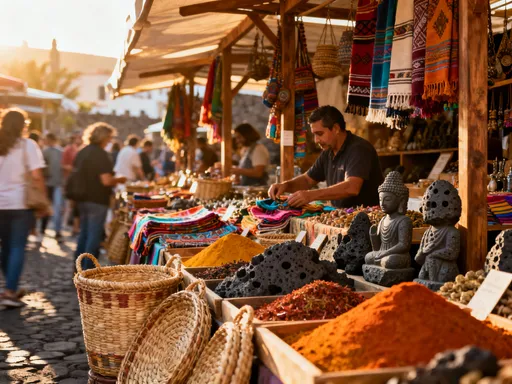
What makes Naqsh-e Jahan truly remarkable is not just its architecture, but the way it is lived in. At dawn, the square is nearly empty, bathed in soft gold as street cleaners sweep the stone paths. By mid-morning, families arrive—children darting across the open space, elders strolling arm in arm, couples pausing for photographs beneath the towering arches. Artisans set up small tables selling miniature tile replicas, hand-painted fans, and delicate silver jewelry. Nearby cafés spill onto the pavement, their low tables crowded with locals sipping tea from clear glasses, sugar cubes held delicately between their teeth. The call to prayer echoes from the mosque, and for a moment, the bustle softens, a collective pause in reverence. This is culture not preserved behind glass, but performed daily, effortlessly.
The Art of Tilework: A Thousand Hues of Devotion
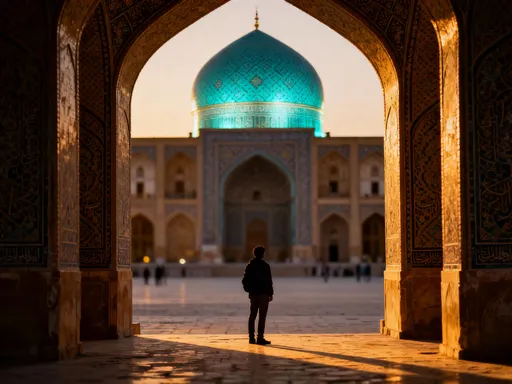
Isfahan’s soul is perhaps most vividly expressed in its tilework, a centuries-old tradition that transforms walls, domes, and minarets into radiant tapestries of color and meaning. Walking through the city, one cannot help but be drawn upward—to the shimmering blues, greens, and golds that crown its most sacred spaces. The mosques of Sheikh Lotfollah and Imam Mosque are masterpieces of this craft, where every inch of surface tells a story through pattern, pigment, and precision. These are not mere decorations; they are acts of devotion, where beauty serves as a bridge to the divine.
The technique behind Isfahan’s tilework is known as haft-rangi, or “seven-color,” a method perfected during the Safavid era. Unlike earlier mosaic styles that used individually cut tiles, haft-rangi involves painting colored glazes directly onto a single tile before firing, allowing for greater detail and a broader palette. The result is a fluidity of design—floral arabesques that seem to grow organically from the walls, geometric patterns that stretch into infinity, and calligraphic bands that flow like rivers of ink. The colors themselves carry symbolism: cobalt blue represents the heavens, turquoise evokes purity, and white signifies light and divinity. Together, they create a visual language that transcends words.
Equally significant are the inscriptions embedded within the tilework. Quranic verses, poetic couplets, and the names of rulers and artisans are woven into the designs, often in elegant nastaliq script. These are not mere labels; they are integral to the spiritual function of the space. In the Sheikh Lotfollah Mosque, for instance, the dome’s interior is painted to resemble a peacock’s tail, its feathers radiating outward in concentric rings of tile. As light filters through the small windows, the colors shift with the hours of the day, creating a dynamic interplay between art and time. Visitors often stand in silence beneath this celestial canopy, not out of obligation, but out of awe—a testament to the power of art to inspire contemplation.
Craftsmanship Alive: From Calligraphy to Carpet Weaving
Beyond the grand monuments, Isfahan’s artistic legacy thrives in the hands of its craftsmen, whose workshops line the narrow alleys behind the bazaars. Here, tradition is not preserved as a relic, but practiced with pride and precision. A short walk from Naqsh-e Jahan leads to a network of ateliers where calligraphers, tilemakers, and carpet weavers spend their days continuing lineages that stretch back generations. These are not tourist performances; they are livelihoods rooted in discipline, patience, and deep cultural knowledge.
Calligraphy, in particular, holds a revered place in Persian culture, and Isfahan is one of its living centers. In a small studio near the Jameh Mosque, a master calligrapher sits cross-legged on a woven mat, his right hand moving with deliberate grace across a sheet of handmade paper. He uses a reed pen, freshly trimmed, dipping it into ink made from soot and rosewater. His script—a flowing nastaliq—forms verses from Hafez, the beloved 14th-century poet. When asked why he continues this painstaking work, he smiles and says, “Writing poetry by hand is like praying with your eyes open.” His words are echoed in the city itself: calligraphy appears on mosque walls, tombstones, café signs, and even the labels of spice jars in the bazaar, a constant reminder that language, when beautifully rendered, becomes art.
Equally profound is the tradition of carpet weaving, a craft that embodies both aesthetic mastery and cultural memory. In a family-run workshop on the eastern edge of the city, women and men sit at upright looms, their fingers moving in rhythmic unison as they knot wool and silk thread into intricate patterns. Each carpet tells a story—some depict gardens of paradise, others map ancient myths or regional histories. Floral motifs dominate, but every curve and color carries meaning. Red symbolizes life and courage, blue stands for spirituality, and ivory represents purity. A single carpet can take months, even years, to complete, with thousands of knots per square inch. These are not products; they are heirlooms, made to be passed down, not sold off quickly. Visitors who take the time to sit and speak with the weavers often leave with more than a purchase—they carry a deeper understanding of what it means to create with intention.
The Hidden Courtyards: Gardens of Reflection and Light
One of Isfahan’s quietest treasures lies in its gardens and private courtyards, spaces designed not for spectacle, but for serenity. Rooted in the ancient Persian concept of *chahar bagh*—a four-part garden divided by water channels—these green sanctuaries reflect a worldview in which balance, symmetry, and nature are intertwined. The most renowned example is Fin Garden, located just outside the city, a UNESCO-listed site that has offered respite to scholars, poets, and travelers for over five centuries. But equally moving are the lesser-known mansion courtyards tucked within old residential neighborhoods, where families gather under grape arbors and fountains murmur in the shade.
Fin Garden is a masterpiece of hydraulic engineering and poetic design. Its water channels, fed by a natural spring, flow in straight lines from a central pool, symbolizing the four rivers of paradise described in Islamic tradition. Cypress trees—symbols of eternity—stand in precise rows, their dark forms contrasting with bursts of roses, jasmine, and pomegranate blossoms. Pavilions with arched windows provide vantage points, not for grand views, but for intimate moments of reflection. It is easy to imagine poets composing verses here, or scholars debating philosophy beneath the cool tile ceilings. Even today, visitors walk slowly, speaking in hushed tones, as if the garden itself demands a certain reverence.
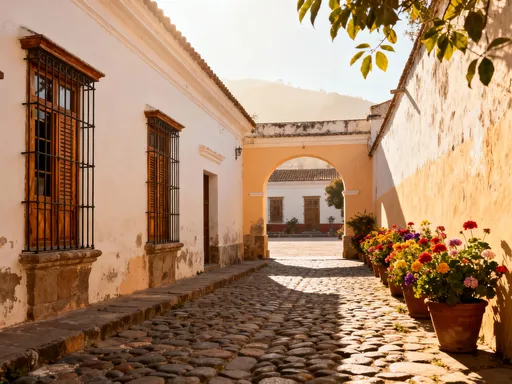
Within the city, traditional homes often feature interior courtyards open to the sky, where sunlight filters through wooden latticework and pots of herbs line the stone steps. These spaces are not merely architectural features; they are the heart of domestic life. Families eat, converse, and receive guests in these courtyards, where the play of light and shadow changes with the seasons. In summer, the fountains provide natural cooling; in winter, low walls trap the sun’s warmth. For the traveler, being invited into such a space—even briefly, through a guided tour or a shared cup of tea—is a rare privilege, a glimpse into a way of living that values stillness as much as activity.
Flavors of Culture: Food as Artistic Expression
In Isfahan, cuisine is not merely sustenance; it is another form of artistic expression, where flavor, fragrance, and presentation converge to create an experience. The city has long been celebrated for its refined palate, shaped by its location on ancient trade routes and its access to high-quality local ingredients. Saffron, cultivated in the surrounding fields, infuses rice dishes with a golden hue and delicate aroma. Rosewater, distilled from petals grown in nearby gardens, sweetens desserts and perfumes the air of traditional confectioneries. Even the bread—crisp on the outside, soft within—carries a craftsmanship all its own.
One of the most distinctive dishes is *kuku esfahani*, a savory herb-and-egg bake layered with walnuts and barberries, often served during Nowruz, the Persian New Year. Its vibrant green color and complex flavor profile reflect the Persian love for balance—sweet and sour, rich and fresh, bold and subtle. Equally iconic are the city’s sweets, such as *sohan*, a brittle saffron toffee studded with pistachios, and *nan-e berenji*, delicate rice cookies flavored with rosewater and dusted with powdered sugar. These are not mass-produced treats; they are made in small batches, often in family-run shops that have operated for decades.
To dine in Isfahan is to participate in a ritual. Traditional *sofreh* houses—modest, home-style restaurants—set low tables on woven mats, where guests sit on cushions and eat with their hands. Meals unfold slowly, beginning with a spread of fresh herbs, cheese, and flatbread, followed by stews simmered for hours and fragrant rice cooked to perfection. Music may be played—a soft melody on the tar or setar—or stories may be shared by the host. The emphasis is not on speed or efficiency, but on hospitality, connection, and appreciation. Every dish is presented with care, often garnished with edible flowers or arranged to resemble a miniature garden. In this way, food becomes a mirror of the city’s soul: thoughtful, beautiful, and deeply human.
Navigating Isfahan: Practical Wisdom for Deeper Connection
To truly experience Isfahan, timing and intention matter as much as itinerary. The best moments often occur outside peak hours, when the crowds thin and the city reveals its quieter rhythms. For instance, visiting Naqsh-e Jahan Square at sunrise allows one to witness the play of light on tilework without distraction, while a late afternoon stroll through the bazaar offers the chance to see artisans at work, their hands moving with practiced ease. Similarly, Fin Garden is most peaceful in the early morning, when mist still clings to the cypress trees and the first visitors arrive with notebooks and cameras.
Understanding local customs enhances the journey. Dressing modestly—women in long sleeves and headscarves, men in neat, conservative attire—shows respect and fosters warmer interactions. Greetings matter: a simple “Salam” (hello) and a hand over the heart can open doors more effectively than any guidebook. When entering a shop or home, it is customary to remove shoes, and accepting a cup of tea is often more important than making a purchase. These gestures are not formalities; they are expressions of *mehman nawazi*, the Persian tradition of hospitality, which holds that guests are a blessing, not an inconvenience.
Getting around Isfahan is both simple and rewarding on foot. The central area is compact, and walking allows for serendipitous discoveries—a hidden courtyard, a street musician playing the ney, a vendor offering samples of fresh dates. When longer distances are needed, reputable taxi services are widely available, and drivers often double as informal guides, sharing stories about the city’s neighborhoods. Ride-hailing apps function reliably, and public buses connect major sites, though they are less necessary for most travelers. The key is to move mindfully—pausing often, observing closely, and allowing the city to unfold at its own pace.
Conclusion
Isfahan doesn’t simply display art and culture—it invites you to live inside them. The true journey isn’t measured in miles, but in moments of wonder: a dome catching the morning light, a craftsman’s proud smile, a shared silence in a sunlit garden. This city teaches that beauty isn’t just seen—it’s felt, remembered, carried forward. Let it reshape how you see the world.